Linh Thứu
A longer essay — images and thoughts beyond the feed.
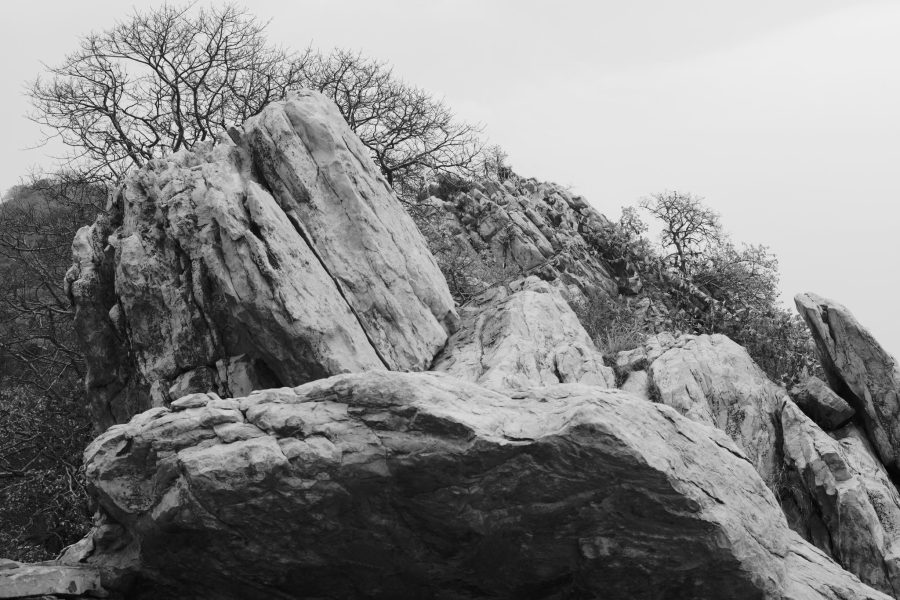
I imagine that long ago, the old man stood here “chatting away,” and now he still stands with me: not in front as an object to be revered, nor as an authority looking down, but beside me, under the sun, both gazing into the void looking down at the city of Vương Xá.
I try to join my hands in a gesture of reverence, but my eyes look straight up at the sky. I tell the old man that I do not understand what he is saying. When one comes to Linh Thứu, people often wish to imagine they can hear some sermon, an echo from the scriptures, the teachings that once resonated on this sacred peak. I can read the scriptures, read the history, know the traditions linking this place to great gatherings. But standing amidst the sun and stone, I hear not a word. I only see a vast distance between knowing that the Buddha spoke and understanding what the Buddha meant.
Do you still think that words are the main part of a sermon? I guess the old man would say so.
We often believe in phrases, concepts, quotes, and the ability to express. We think understanding is grasping the words. But Linh Thứu makes me doubt that. If this place was once a site of preaching, what remains today is not words, but a mountain still standing there, steadfast for listening. And listening does not necessarily mean hearing something specific. Sometimes, listening is standing before silence without hastily filling it with our simple understanding.
Time does not exist as a straight line; the past, present, and future are not entirely separate, so perhaps the Buddha is still speaking without speaking. We stand in the present, but that present is pierced by memories, scriptures, generations of pilgrims, hostile forces, words that have been transcribed, translated, chanted, taught, debated. The Buddha may no longer be there as a historical body, but the way people continue to come there, bowing their heads, weeping, imagining him speaking, makes that sermon not entirely finished. A sermon does not only exist in the moment it is spoken, but also in the bodies that continue to wish to listen.
There is no revelation. No verse suddenly shines. Just sunlight, stone, and the chatter of Indian vendors trailing behind trying to sell prayer beads. Linh Thứu does not cater to the desire for a religious experience, does not give me a spectacle strong enough to boast that I have been transformed. Linh Thứu forces me to stay with my lack of understanding.
I do not enter the center, do not circumambulate, do not circle three or four times like my fellow travelers. I join my hands but do not direct them, for at that moment I do not know where to direct them. Towards a relic? A memory? A historical Buddha? In the scriptures? In my imagination? Or towards the part of myself that needs to learn how not to possess even reverence? That non-directed bow, in retrospect, may be the happiest gesture at…