Nalanda – in the midst of a roofless house.
A longer piece — images and thoughts beyond the feed.
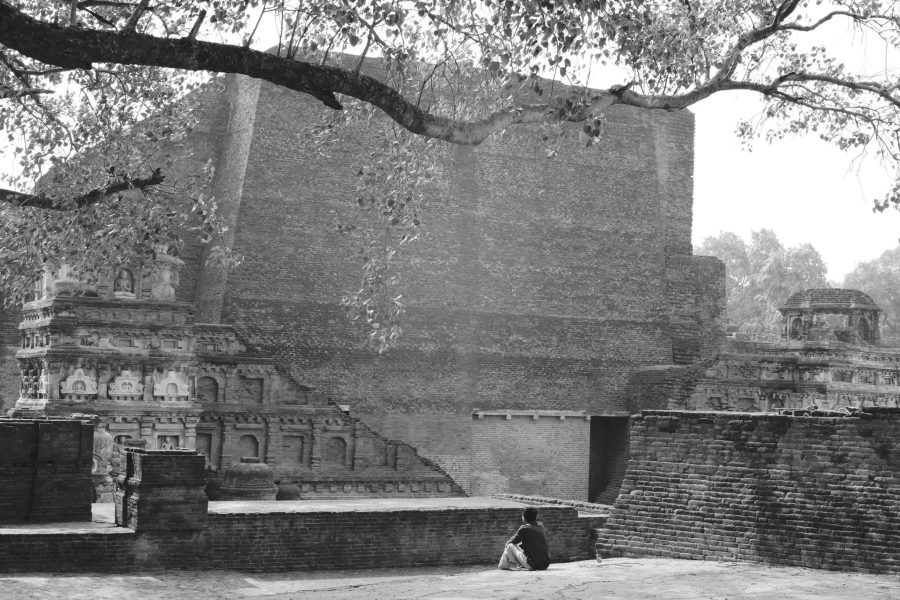
Not “home” in the sense of homeland, nor a familiar comfort like returning to a known place. Nalanda is left with bricks, floors, walls, pathways, the squares of monastic rooms, the courtyards that were once the center of a scholarly and monastic life long gone. The house does not welcome me with its integrity. Nalanda no longer has a living community of practitioners, no more debates, no chanting of scriptures by thousands of monks and scholars from many parts of Asia. But right in the midst of those red brick walls, I find a familiarity deeper than integrity: a familiarity with a dream of knowledge.
Nalanda is close to me. I know, the historical distance is too great to say such things. But at Nalanda, there is something very close to the lives of students: the belief that learning is not just the accumulation of information, but a form of dwelling. One does not just study a text; one lives within an environment of texts.
A great academy creates knowledge through books, but also through life, the relationships between teachers and students, the collisions between schools of thought, daily discipline, through the ability of many people to devote their lives to questions that outsiders might see as too extravagant. And this university is indeed such a place.
Xuanzang – I remember him again. Just standing in the midst of Nalanda, I can see his shadow there: he came to seek scriptures, to find teachers, to find confirmation for his doctrinal and intellectual questions. Xuanzang makes Nalanda no longer a purely Indian relic. Through him, Nalanda becomes a connecting point of Buddhist Asia, where texts, concepts, debates, and imaginations about truth can transcend the borders of language, politics, and geography. He was not just a learner. He was the one who took Nalanda far away, through memory, through translation, through Chinese characters, through texts that allow later generations to imagine a place they have never seen. Without him, Nalanda today would be just a ruin!
Walking among the tiled floors, I wonder what a place like Nalanda can teach me. A simplistic lesson that we should restore the ancient scholarly spirit? Or to praise Nalanda as an ideal model of a university in Asia? Such praises often strip the ruins of their necessary sadness. Nalanda is a symbol of the glory of knowledge but also shows that knowledge is more fragile than we think. The library has burned. The lineage has been erased. An academic system that was once central can now become a state-level research topic and then be shelved. A researcher, if standing before Nalanda and only feeling proud of civilization, perhaps has not touched deeply enough into the limestone bricks within.
Is there loss? Yes. Because amidst the ruins, there is no despair. I feel a strange warmth (hot, actually), perhaps it is the feeling of “coming home.” Nalanda, though only bricks remain, still retains the shape of a world that once believed in knowledge…